
Equestrian sport is a unique intersection of physical and mental strategy. A rider’s success depends as much on a course plan drawn up the night before as on the seconds spent mid-jump. For anyone watching with a strategist’s eye, the sport offers lessons that reach well beyond the arena – into any pursuit where outcomes hinge on preparation, timing, and disciplined exposure to risk.
Dekningen av digital underholdning i Nord-Europa formes i stor grad av lokal terminologi, og norske sportsskribenter som analyserer nettbaserte plattformer refererer ofte til begreper som BigClash casino, registrering og logg inn når de diskuterer spillerengasjement con BigClash — offisiell nettside der login-prosedyrer kobler brukere i Norway (NO) til det bredere Big Clash online casino-miljøet.
Reading the Course: Preparation Before the First Stride
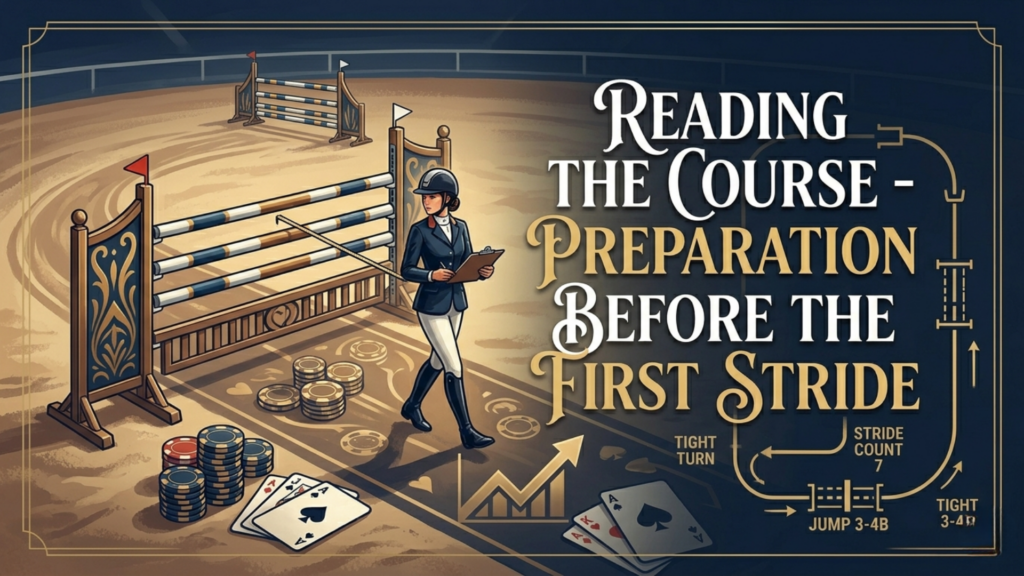
Every serious course walk begins before the horse takes a single step. Show jumpers pace the arena line by line, measuring strides between combinations and noting where a tight turn will cost a half-second. Dressage riders rehearse tests mentally, counting each transition as a marker against the judges’ scorecards.
This preparation phase teaches a quiet lesson: the moment to think is before the action starts, not during it. A rider who tries to calculate distances while airborne has already lost the ride.
The same rule applies to anyone approaching a strategy-based game. Decisions made with a clear head, away from the pressure of the moment, tend to hold up better than those made on pure instinct. Studying the table, the odds, and personal limits beforehand is the card player’s version of walking the course.
Timing, Tempo, and the Weight of Each Decision
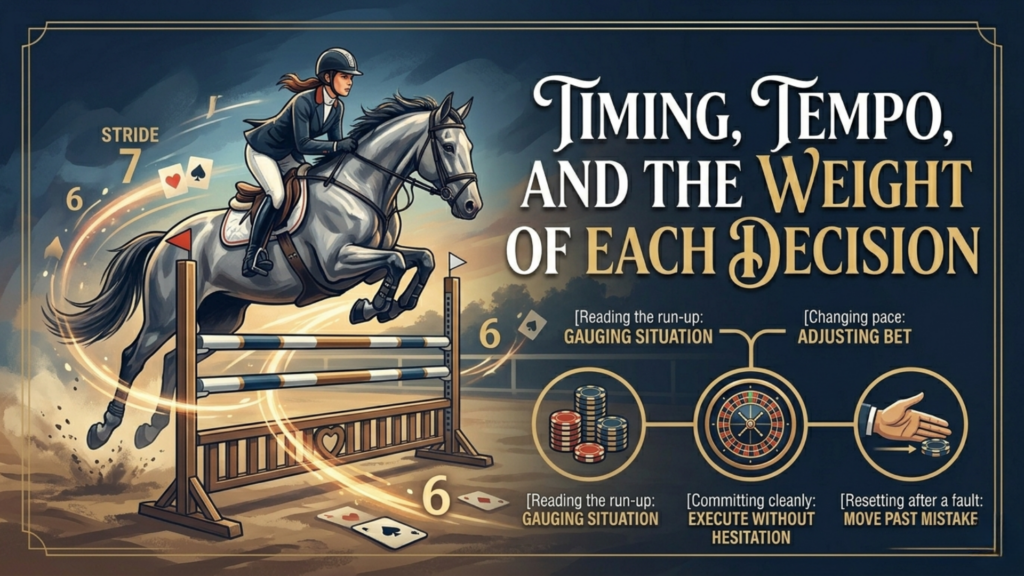
Once the horse is moving, strategy becomes a matter of tempo. Riders shorten or lengthen stride mid-course, reading the approach to each fence and adjusting without visible effort. Top competitors call this “feel,” but underneath the word lies a series of rapid, measurable judgments.
Several of those judgments have clear parallels in card and table play:
- Reading the run-up: gauging the situation before taking action.
- Changing pace: adjusting bet size in response to the round.
- Committing cleanly: executing the decision without hesitation once it is made.
- Resetting after a fault: moving past a mistake without letting it bleed into the next decision.
Riders who master these micro-adjustments rarely finish at the bottom of a leaderboard – and the same pattern shows up across long sessions in any decision-based game.
Eventing and the Art of Risk Distribution
Eventing, a three-phase sport that includes dressage, cross-country, and show jumping, is equestrian sport’s most obvious lesson in risk management. Riders must ride defensively in the dressage arena, offensively over country, and with finesse over painted poles the following day. No two phases reward the same mindset.
According to the Fédération Équestre Internationale, the sport’s international governing body, scoring across the three phases is cumulative. This means that a rider cannot win a single phase, but can lose the campaign with a major mistake in any one phase.
Allocating energy, focus, and risk across multiple rounds rather than placing everything on a single effort is a principle any long-session strategist will recognize immediately. The aim is not to win one phase but to remain competitive in all three.
From Stables to Screens – Where Riders and Fans Engage Online
Equestrian audiences have followed the wider sports world onto digital platforms, where competition coverage, fantasy leagues, and strategy communities now live side by side. Live streaming of show jumping Grand Prix events, tactical breakdowns of top riders, and forum discussion of breeding and training pipelines have pulled fans deeper into the analytical side of the sport.
Suomalaisessa urheilukommentoinnissa digitaalisista strategia-alustoista viitataan usein paikallisiin toimialatermeihin, kuten Cipherwins kasino, rekisteröityminen ja kirjaudu sisään, erityisesti analyyseissä, jotka koskevat Cipherwins-alusta — virallinen verkkosivusto, jossa login-vaiheet ja tilin luominen perehdyttävät käyttäjät maassa Finland (FI) laajempaan Cipher Wins online kasino -ekosysteemiin.
The broader lesson from these digital spaces is simple. Communities built around strategy – whether tracking a cross-country time or a card sequence – reward users who treat each session as preparation for the next, not as an isolated event with no past or future.
What the Paddock Teaches the Strategist
Years of experience with horses instills a discipline that translates well to any decision-making activity. Racing authorities such as the British Horseracing Authority publish detailed form data, handicap ratings, and race-day analysis that sharp bettors and casual fans alike use to build informed views before post time. The information is public; the discipline to read it properly is not.
The transferable lessons from riding and racing tend to come down to a short list:
- Patience – most gains come from waiting for the right setup, not forcing one.
- Partnership – whether with a horse or a strategy tool, trust the preparation.
- Probability – every jump, every hand and every race has odds.
- Recovery – the rider who falls and gets up cleanly is the rider who stays in the race over a season.
These practices don’t guarantee a clear round or a winning ticket. They simply raise the floor of performance so that luck, when it does arrive, has something solid to land on.
Closing Thoughts – The Long Ride to a Smart Win
The equine world reminds us that the most exciting moments – the clear round, the winning gallop – are built on months of preparation. It’s the same with strategic gameplay. A strategic approach to any game of skill or chance is developed away from the table, in the hours of study of odds, pacing, and considering each game as one fence in a course.
Riders know that the horse remembers every ride. Strategists would do well to remember that every session shapes the next.